Every new product starts with a bet on stock
Sellers often buy stock before they know if it will sell. Every new product starts with that bet.
Sellers are the market
- More than 60% of sales in Amazon's store come from independent sellers, most of them small and medium-sized businesses.
- The Etsy marketplace had 5.6 million active sellers as of Dec 31, 2025.
- eBay had 2.5 billion live listings globally at the end of 2025.
Buyers are already global
- US-based independent sellers on Amazon exported more than 580 million items in 2025.
- 26% of Etsy marketplace sales in 2025 came from buyers outside the US.
Every new market means a new bet on what will sell there.
The bet often loses
A study of 83,719 new SKUs in 31 US consumer packaged goods categories, launched from 2002 to 2009, found that 1 in 4 was no longer bought a year after launch. After two years, about 40% were no longer bought.
That's in a home market. In a new market, a seller has even less to go on.
Sellers see demand after they buy
Usually, a seller finds out if a product sells in a new market only after buying the stock, shipping it, and listing it. By then, the money is spent.
The check needs to come before the stock.
What we're building
PreSelling is AI that checks demand for a product in a new market before the seller stocks it, then helps them list it there.
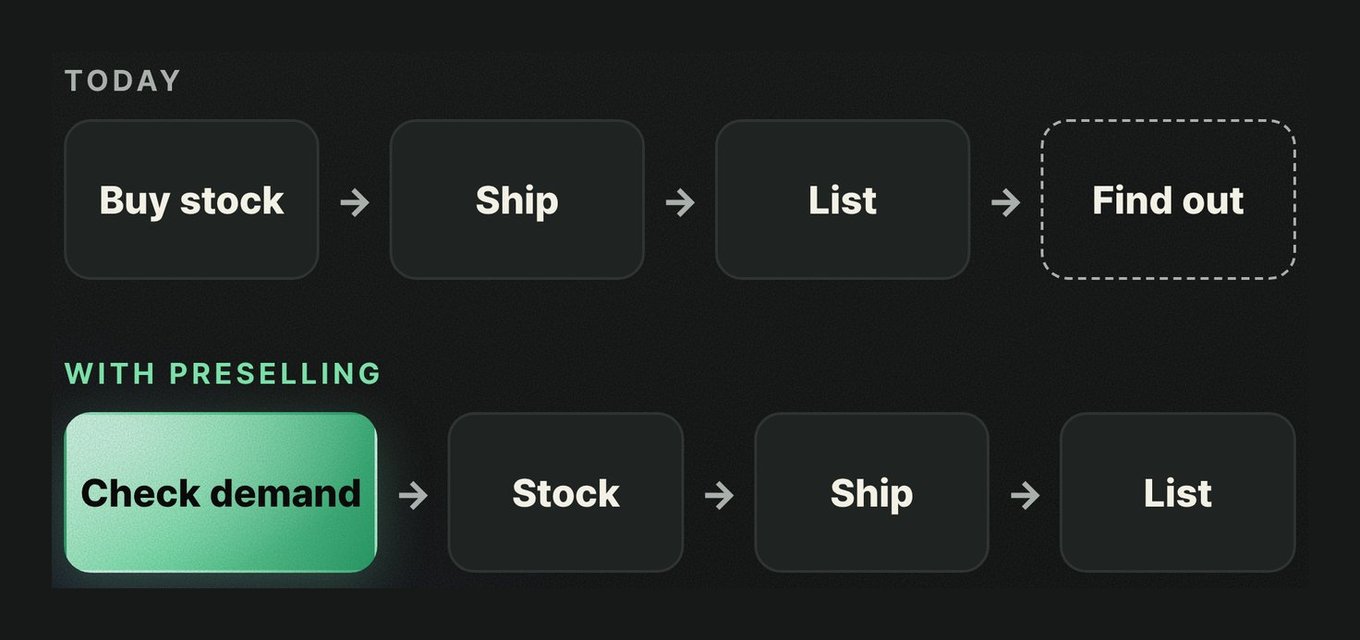
Today, a seller buys stock, ships it, lists it, and only then finds out. With PreSelling, the seller checks demand first, then stocks, ships, and lists.
Sources
- Victory et al., Marketing Letters, 2021 (83,719 new SKUs in 31 US consumer packaged goods categories, launched 2002–2009)