AI gave you a market number. Can you use it?
Ask an AI tool how big the US market is for your product, and you'll get an answer like "It's worth $X billion." A market number decides what you stock and how much. Check it first.
Even AI makers say to verify it. OpenAI's help center tells users to always verify data and references to external documents.
Check 1: Source
Ask where the number came from, then open the link yourself. Find the exact number on that page. No source? Treat it as a guess.
Check 2: Date and scope
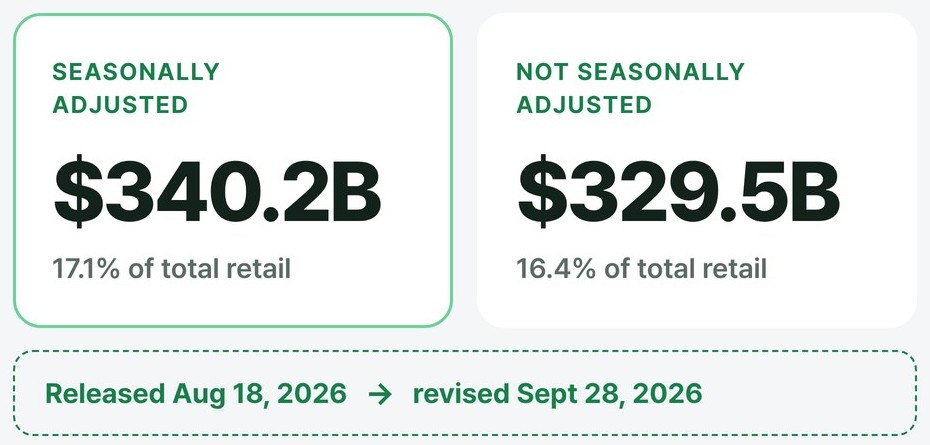
One quarter can have two numbers, and both can change. U.S. retail e-commerce sales for Q2 2026 were $340.2B seasonally adjusted (17.1% of total retail) and $329.5B not seasonally adjusted (16.4%). Both were first released on Aug 18, 2026 and revised on Sept 28, 2026. Check how a number was measured, and whether it's the latest version.
Check 3: Official data
- US: U.S. Census Bureau, Quarterly Retail E-Commerce Sales (sales value and share of retail)
- UK: Office for National Statistics, Retail sales, Great Britain (share of sales made online)
- EU: Eurostat, E-commerce statistics for individuals (share of people buying online)
Official data won't size your product. But it can show when an AI's headline number is off.
Before you use an AI number
- There is a source link
- The number is on that page
- The date is clear and current
- Same country, period, and category
- It lines up with official data
Miss one? Don't use the number yet.
Sources
- OpenAI Help Center, "Does ChatGPT tell the truth?" (opens in a new tab)
- U.S. Census Bureau, Quarterly Retail E-Commerce Sales, 2nd Quarter 2026 (Aug 18, 2026) (opens in a new tab)
- U.S. Census Bureau, 2026 annual retail revision (Sept 28, 2026)